
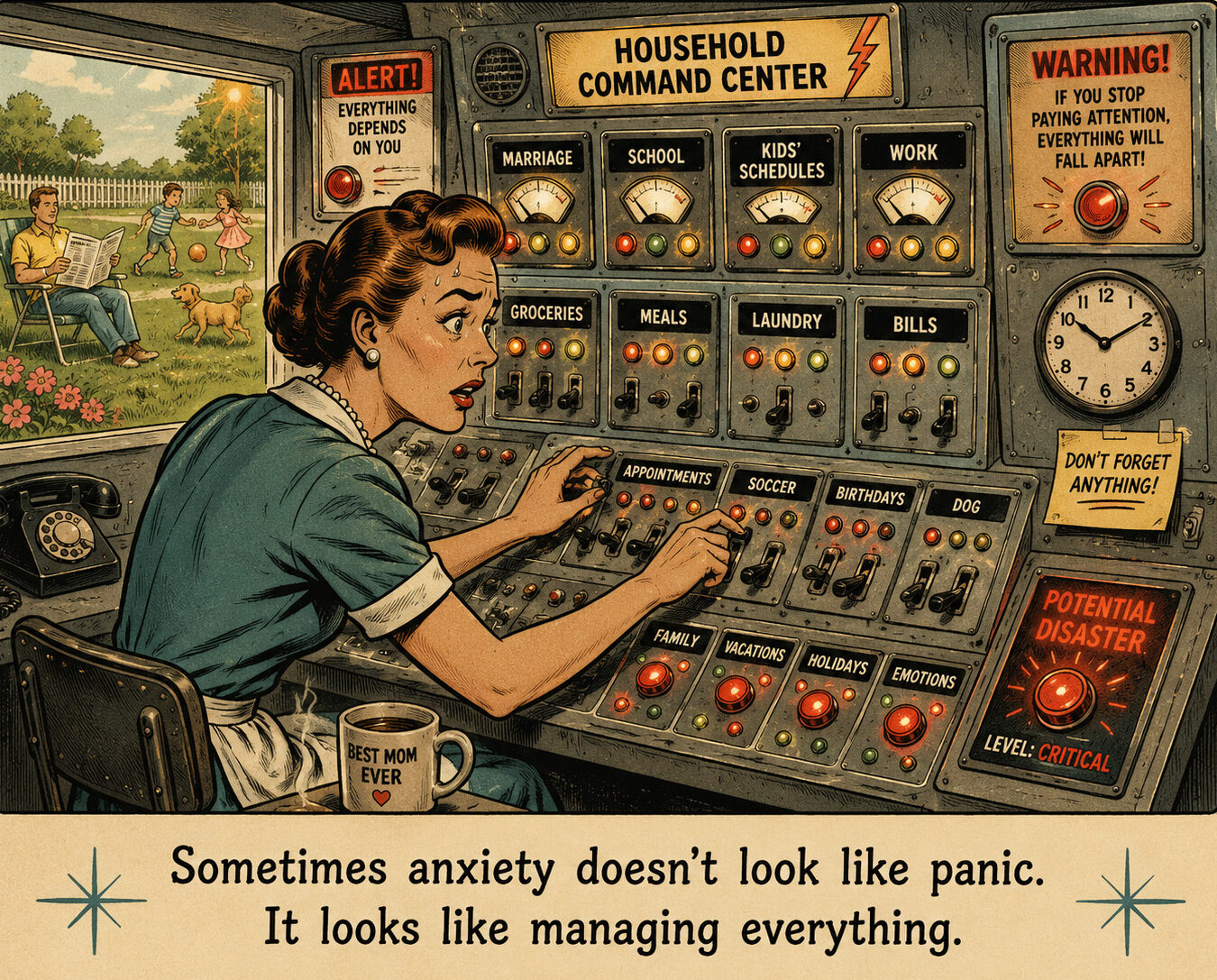
Therapy for the Mental Load
You’re managing
a household and
everyone in it.
You’re managing a household and everyone in it.
No wonder you’re exhausted.
What is the mental load?
The mental load is the invisible work of keeping life running. It’s the constant planning, remembering, anticipating, organizing, and problem-solving that happens quietly in your head every day.
Most people notice the laundry getting folded or dinner getting cooked. Far fewer notice the mental work that happened before those tasks ever began.
Someone had to remember the milk was running low, schedule the dentist appointment, RSVP to the birthday party, refill the prescription, buy the teacher gift, notice the dog food was almost gone, and remember that spirit day is tomorrow.
That someone is often you.
Why does the mental load feel so exhausting?
Your brain wasn’t designed to keep hundreds of tiny responsibilities running in the background all day long.
Even when you’re sitting on the couch, your mind may still be planning dinner, wondering whether your child finished their homework, remembering to return a library book, thinking about an upcoming vacation, and mentally rearranging tomorrow’s schedule.
This is why traditional self-care often falls flat. A bubble bath, massage, or girls’ night can be wonderful, but they don’t quiet a brain that’s still busy managing everyone else’s lives. Self-care is not a waste of time or energy – it just isn’t enough.
When your mind never stops anticipating, planning, and solving problems, it never has the chance to truly rest.
This is cognitive overload. It quietly drains your energy, shortens your patience, affects your relationships, and leaves you feeling exhausted—even after a full night’s sleep.
Your brain never truly gets to clock out.
The mental load affects more than your energy.
Many women assume they’re simply tired or overwhelmed.
But over time, the mental load can show up as:
- Feeling constantly anxious
- Irritability and resentment
- Difficulty relaxing
- Trouble falling asleep because your brain won’t stop
- Feeling disconnected from your partner
- Losing interest in sex
- Feeling like everyone needs something from you all the time
- Wondering why you can’t seem to enjoy your own life
These experiences are incredibly common, but they aren’t something you simply have to accept as part of motherhood or adulthood.
Why do women carry so much?
There isn’t one answer.
Sometimes it’s habit. Sometimes it’s personality. Sometimes it’s anxiety. Sometimes it’s a relationship dynamic that develops gradually over time.
Many of the women I work with are incredibly capable. They’re organized, dependable, and the ones everyone counts on. When you’re the one who remembers everything, plans everything, and fixes everything, people naturally begin relying on you.
The problem is that much of what you do happens behind the scenes. You notice the empty milk jug before anyone else. You remember the permission slip, the birthday gift, the dentist appointment, and the dog’s medication. Because you quietly handle these things before they become problems, the work often goes unnoticed.
Over time, people stop seeing everything you’re carrying because you’ve made it look effortless.
And after a while, it feels easier to keep doing it yourself than to explain it, delegate it, or risk something falling through the cracks. Until one day, you’re done.
How therapy can help
Therapy isn’t about becoming more productive or finding a better calendar. (Hint: Please don’t buy another planner.)
It’s about understanding why you’ve been carrying so much in the first place.
Together, we’ll explore the beliefs, habits, and relationship patterns that keep the mental load on your shoulders. We’ll work on boundaries, communication, realistic expectations, and finding ways to let your brain finally rest.
You don’t need another bubble bath. And you probably don’t need another planner.
You need your brain to stop believing it’s responsible for everyone and everything. The goal isn’t to help you do more. It’s to help you carry less. That’s the work we do in therapy.
Explore more about the mental load

ADHD looks different in women, especially after 40 when hormonal shifts and midlife responsibilities pile on. Discover practical strategies and how personalized ADHD coaching can help you turn overwhelm into clarity.